The AI Tautology Crisis Is a Data-Provenance Failure
Models are starting to learn from their own outputs while clean human text runs short — that recursive loop is real, measurable, and governable if you treat training data like infrastructure, not an infinite crawl.
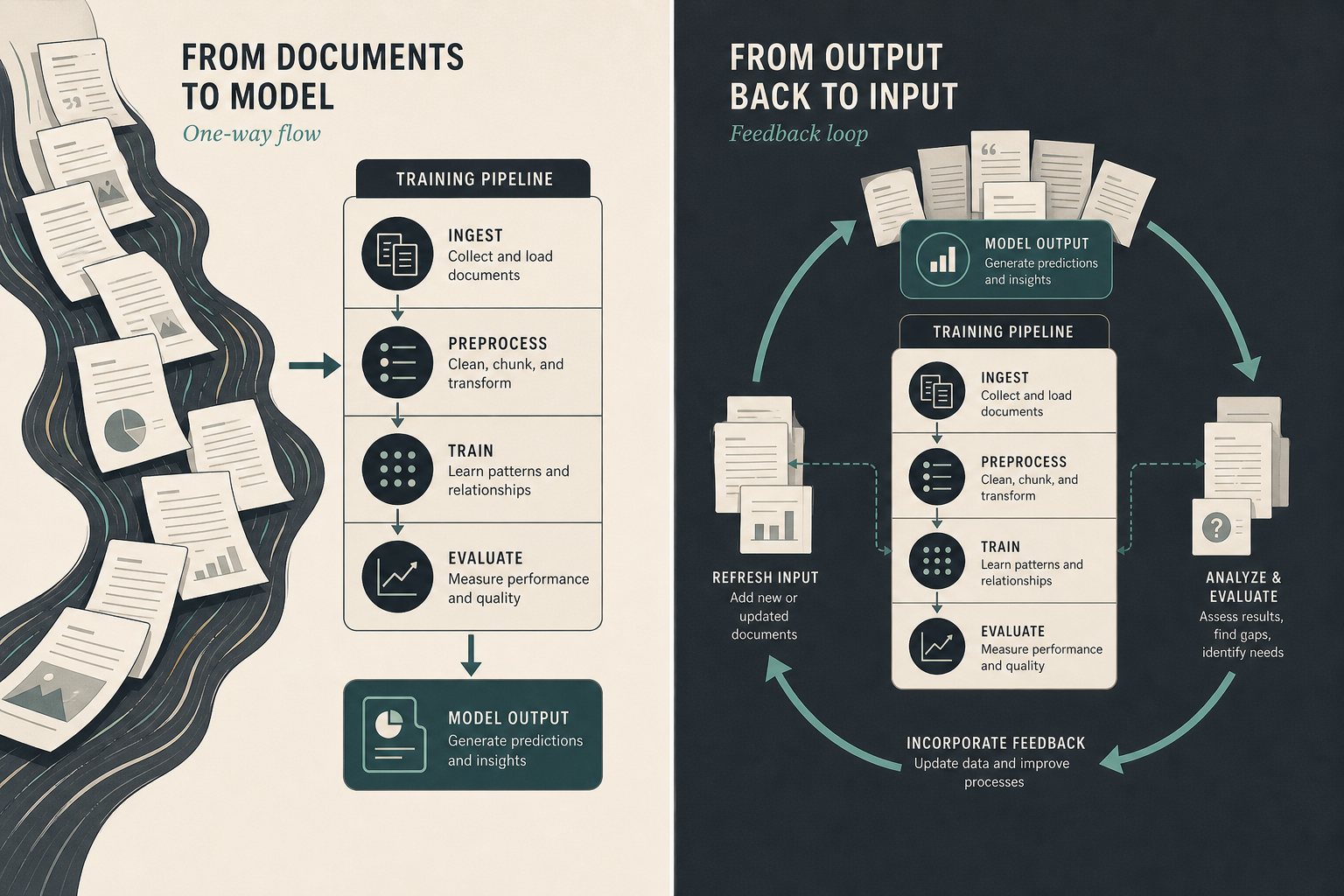
Most frontier training pipelines still behave as if the next web scrape brings more of the world. The measurable reality is different: a rising share of public text is model output, high-quality human-origin data is depleting on a known timeline, and demand for tokens still doubles on schedule. A data lead I spoke with last quarter put it without drama: "We're not running out of pages. We're running out of pages that weren't written by us or our competitors."
That is what people mean by an AI tautology crisis — not a philosophical riddle, but a feedback loop in which systems trained on synthetic and recycled text gradually teach on their own shadow. If that phrase is new, the one-sentence version worth keeping is: the corpus starts to cite the model more often than the world. The governance question is whether anyone can prove — at training time — what fraction of a batch is still human-origin signal.
Model Collapse — What the Recursive Loop Does
Researchers call the degenerative end state model collapse: when generative models are trained recursively on data produced by earlier models, the learned distribution narrows, rare patterns vanish, and later generations mis-perceive the underlying task. Shumailov and colleagues, including Oxford-affiliated authors, demonstrated this across text, images, and other settings in Nature — not as a thought experiment, but as a progression across generations of retraining.
The mechanism is statistical, not mystical. Each generation samples from the previous model's output; tails of the original distribution disappear; variance shrinks. What remains reads fluently but carries less of the world's oddity — the rare facts, dialects, failures, and edge cases that humans actually produce. Benchmarks focused on average accuracy can miss the early stages because the centre of the distribution still looks fine while diversity bleeds out.
Granted, synthetic data is not uniformly poison. In narrow domains with verifiable rewards — structured mathematics, some coding tasks — curated synthetic generation has shown value. The failure mode is replacement: treating synthetic volume as a substitute for verified human-origin data in general pre-training, especially when the synthetic share of the open web is unknown and rising.
The Data Stock — Demand, Quality, and Exhaustion
Collapse is a recursion problem. Exhaustion is a stock problem. They meet in the same pipeline.
Epoch AI's forecasting work on human-generated public text estimates a finite stock and projects full utilization between 2026 and 2032 at 80% confidence. Related projections suggest high-quality language data may face effective exhaustion even earlier — before 2026 in one median intersection — while dataset sizes continue to grow faster than the underlying stock. In plain terms: teams still schedule bigger training runs, but the pool of clean human text they trust is not growing at the same rate.
That asymmetry is the supply-side half of the tautology crisis. Demand is institutional and competitive — every foundation-model cycle wants more tokens. Supply of verified human-origin tokens is flat or falling as platforms fill with assistive writing, SEO slop, and model summaries. Licensing pre-2022 corpora and publisher archives for eight- and nine-figure sums is the market admitting the gap; it is not a business fad, it is procurement for non-tautological signal.
The fair version of the objection: private human data — messaging, enterprise documents, licensed archives — expands the stock outside public crawl. That is true for some trainers. It does not resolve provenance for the open-web paradigm that built the current generation, and it raises equity and consent questions this piece cannot fully treat. The point stands: public crawl is the canary, and the canary is breathing synthetic air.
Data Provenance as Governance — Not a Metadata Hobby
Technical AI governance, in the Oxford AIGI sense, is the work of closing gaps between what policy wants and what engineers can verify. Applied here, the policy desideratum is simple to state and hard to enforce: no training generation should silently increase synthetic share without measurement.
Mechanism sketch — three trust boundaries:
- Ingestion. Every crawl slice carries provenance metadata: capture date, source class, detector scores for synthetic likelihood, contractual licence where applicable.
- Mixing. Training recipes declare human-origin floors and synthetic ceilings; changes require versioned approval like any safety-critical config.
- Evaluation. Pre-release evals report diversity and tail-coverage metrics, not only benchmark accuracy — early collapse shows up in the tails first.
Data provenance — the documented chain of custody for what entered the batch — is what makes those boundaries auditable. If that term is load-bearing here: it is the answer to "show me the human-origin share," not a copyright footnote. Without it, "we trained on the internet" means "we trained on an unmarked blend of world and model," which is the tautology in infrastructure clothing.
Policy to Verification — a Pilot Stack You Can Actually Run
Take one obligation in institutional language: maintain a verified human-origin floor in pre-training data. Translate it into a verification pilot small enough to falsify cheaply:
- Baseline audit. Sample the current corpus; estimate synthetic likelihood by stratified source; publish internally (human floor %, confidence interval).
- Filter policy. Down-weight or exclude slices above a synthetic score threshold; up-weight licensed human archives; document false-positive checks on human text.
- Accumulation rule. Retain prior verified human slices when adding new synthetic-augmented data — do not replace-by-default. Gerstgrasser et al. show accumulation of real data alongside synthetic generations can avoid collapse where replacement fails.
- Ratio bound. Set a maximum synthetic fraction per stage; statistical work on mixed training implies collapse is inevitable on synthetic-only data, but controlled mixtures can bound deviation from the original distribution.
- Diversity gate. Require tail metrics (rare n-grams, long-tail topic coverage, dialect presence) before scaling compute on the new mix.
- Attestation. Ship a data card with the release stating human-floor %, synthetic ceiling, provenance version — the governance interface for downstream regulators and customers.
Each step proves or disproves something. Skipping straight to "we feel the crawl is fine" is how tautologies become policy.
Where Tautology Governance Fails — a Stress Test
Ordinary failure: Teams measure volume (tokens ingested) instead of provenance (human-origin share). Volume KPIs reward the crisis.
Incentive bends: Shipping the next checkpoint beats auditing the corpus. Synthetic augmentation is fast; provenance audit is slow. Without release gates, slow work loses every sprint.
Reality drift: Detectors trained on last year's models miss this year's generators. A filter that worked for one model class fails on agentic multi-step publishing. Governance must version detectors and re-baseline human floors on a cadence tied to deployment, not to annual compliance theatre.
The Nature authors note a first-mover advantage: models trained before mass synthetic pollution of the crawl retain access to cleaner human signal. Late entrants inherit the loop. That is not an argument for stopping research; it is an argument for treating provenance as strategic infrastructure while cleaner stock still exists.
What the Field Should Verify Next
The AI tautology crisis is real enough to name: recursive training on unmarked synthetic-heavy corpora narrows what models know of the world, while human-origin text depletes under sustained demand. It is not yet a reason for theatrical panic. It is a reason to govern data the way we govern other load-bearing inputs — with ratios, audits, and release attestation.
Which training pipeline in your organisation still equates "more tokens" with "more learning" — and what would a human-origin floor measured at ingest actually show?